How to Subtract Fractions with Unlike Denominators
Learn to find a common denominator, rewrite each fraction, then subtract. Follow the worked examples, then try it yourself.
See It
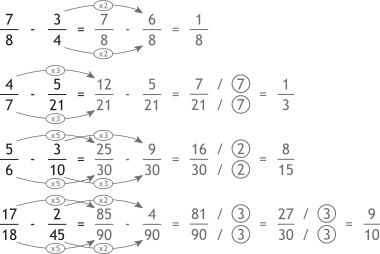
Study the worked examples below. Each step is shown so you can follow exactly how the problem is solved.
Do It
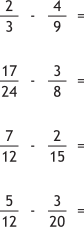
Now it's your turn. Grab a pencil and paper and try these problems using the method you just studied.
Check It
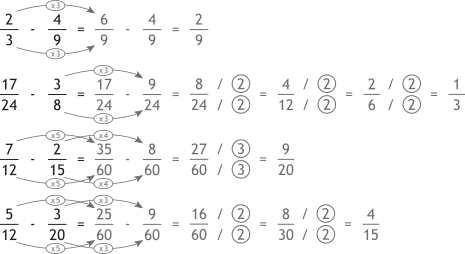
Done? Reveal the answer key to check your work.
How Do You Subtract Fractions with Unlike Denominators?
Just like adding, subtracting fractions with different denominators requires a common denominator first. You can't take away pieces that are different sizes — 3/4 minus 1/3 doesn't work until both fractions use the same denominator.
Find the least common multiple of the denominators, convert each fraction, then subtract the numerators and keep the common denominator. For example, 3/4 − 1/3 becomes 9/12 − 4/12 = 5/12.
Subtracting fractions with unlike denominators is used constantly in real life — from measuring remaining ingredients to calculating differences in distances. The process is almost identical to adding unlike fractions, so if you've mastered addition, subtraction follows naturally.
This Is One Activity From Book 2: Fractions
The full book has 40 activities just like this one — each with worked examples, matching practice problems, and a complete answer key. No tutor needed. No app. Just a pencil and a workbook.
Get Fractions — $40