How to Simplify Fractions
Learn to reduce fractions to their simplest form by systematically dividing both the numerator and the denominator by prime numbers in ascending order — starting with 2, then 3, then 5, and so on — repeatedly until no further division is possible. Follow the worked examples, then try it yourself.
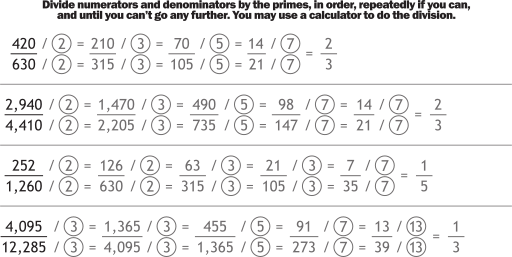
See It
Study the worked examples below. Each step is shown so you can follow exactly how the problem is solved.
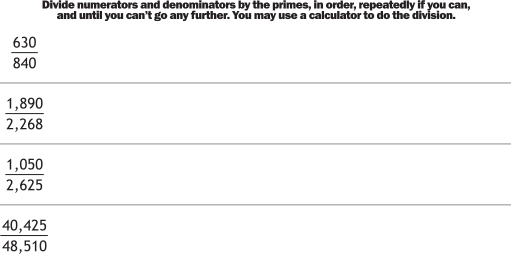
Do It
Now it's your turn. Grab a pencil and paper and try these problems using the method you just studied.
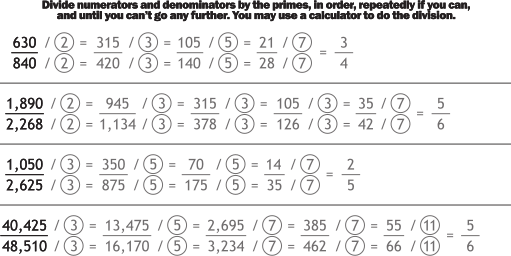
Check It
Done? Reveal the answer key to check your work.
What Does It Mean to Simplify a Fraction?
Simplifying a fraction means reducing it to its lowest terms — finding an equivalent fraction where the numerator and denominator share no common factor other than 1. For example, 6/8 simplifies to 3/4 because both 6 and 8 are divisible by 2.
The key skill is systematically dividing the numerator and denominator by prime numbers (2, 3, 5, 7, etc.) in order. By repeatedly dividing by the smallest possible prime until you can’t go any further, you arrive at the simplest form with the same precision as a calculator. This step-by-step method eliminates the guesswork and common mistakes often found when trying to hunt for the greatest common factor (GCF) all at once.
Simplifying fractions is a foundational skill used throughout math — from adding fractions with unlike denominators to solving algebraic equations. Mastering it now makes every future topic easier.
This Is One Activity From Book 2: Fractions
The full book has 40 activities just like this one — each with worked examples, matching practice problems, and a complete answer key. No tutor needed. No app. Just a pencil and a workbook.
Get Fractions — $40