How to Multiply Fractions
Learn to multiply straight across — numerator times numerator, denominator times denominator — then simplify. Follow the worked examples, then try it yourself.
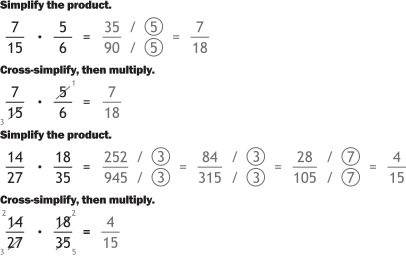
See It
Study the worked examples below. Each step is shown so you can follow exactly how the problem is solved.
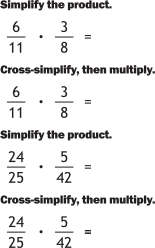
Do It
Now it's your turn. Grab a pencil and paper and try these problems using the method you just studied.
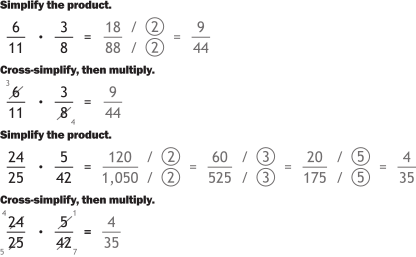
Check It
Done? Reveal the answer key to check your work.
How Do You Multiply Fractions?
Multiplying fractions is simpler than adding or subtracting them — you don't need a common denominator. Just multiply the numerators together to get the new numerator, and multiply the denominators together to get the new denominator. For example, 2/3 × 3/4 = 6/12, which simplifies to 1/2.
You can also simplify before multiplying by cancelling common factors across the numerators and denominators. This keeps the numbers smaller and makes the final answer easier to reach. For instance, in 2/3 × 3/4 you can cancel the 3s first, giving 2/1 × 1/4 = 2/4 = 1/2.
Multiplying fractions shows up everywhere — scaling recipes, finding a fraction of a fraction, calculating area, and probability. It's one of the most useful fraction operations and a stepping stone to dividing fractions.
This Is One Activity From Book 2: Fractions
The full book has 40 activities just like this one — each with worked examples, matching practice problems, and a complete answer key. No tutor needed. No app. Just a pencil and a workbook.
Get Fractions — $40