How to Do Long Division with Remainders
What happens when a division problem doesn't come out evenly? You get a remainder. This lesson shows you exactly how to handle remainders in long division with worked examples.
See It
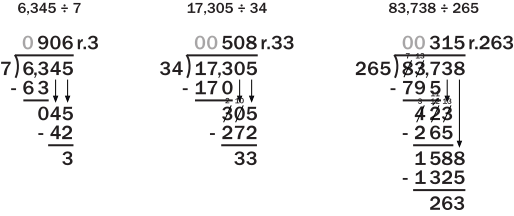
Study the worked examples below. Each step is shown so you can follow exactly how the problem is solved.
Do It
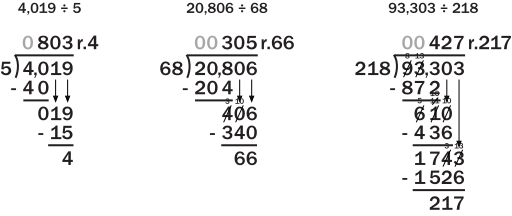
Now it's your turn. Grab a pencil and paper and try these problems using the method you just studied.

Check It
Done? Reveal the answer key to check your work.
What Is a Remainder in Division?
A remainder is what's left over when a number doesn't divide evenly. If you divide 17 by 5, you get 3 with a remainder of 2 — because 5 goes into 17 three times (5 × 3 = 15) with 2 left over.
The long division process is the same as regular long division — divide, multiply, subtract, bring down — but at the end, instead of getting zero, you have a number left. That leftover number is your remainder, and it must always be smaller than the divisor.
Remainders trip up a lot of students because it feels like something went wrong. It didn't — some numbers just don't divide evenly, and knowing how to handle that is an essential skill. This lesson walks through examples and gives you practice until remainders feel routine.
This Is One Activity From Book 1: Basic Math Operations
The full book has 50 activities just like this one — each with worked examples, matching practice problems, and a complete answer key. No tutor needed. No app. Just a pencil and a workbook.
Get Basic Math Operations — $40